What is GEO, and how is it different from SEO?
Search engines now answer questions instead of only listing links. GEO is the work of getting your pages cited inside those answers.
 By Mahmoud Barakat
Search used to mean ten blue links. Today a traveller can ask ChatGPT, Google's AI Overviews or Copilot "what's the best way to see Luxor in two days?" and get one written answer, with a handful of sources underneath it. Generative Engine Optimisation (GEO) is the work of becoming one of those sources.
The name comes from a 2023 research paper by Aggarwal and colleagues, which tested ways of changing web content and found they could raise a source's visibility in AI answers by up to 40% — with results that varied by topic (arXiv, 2023).
SEO and GEO side by side
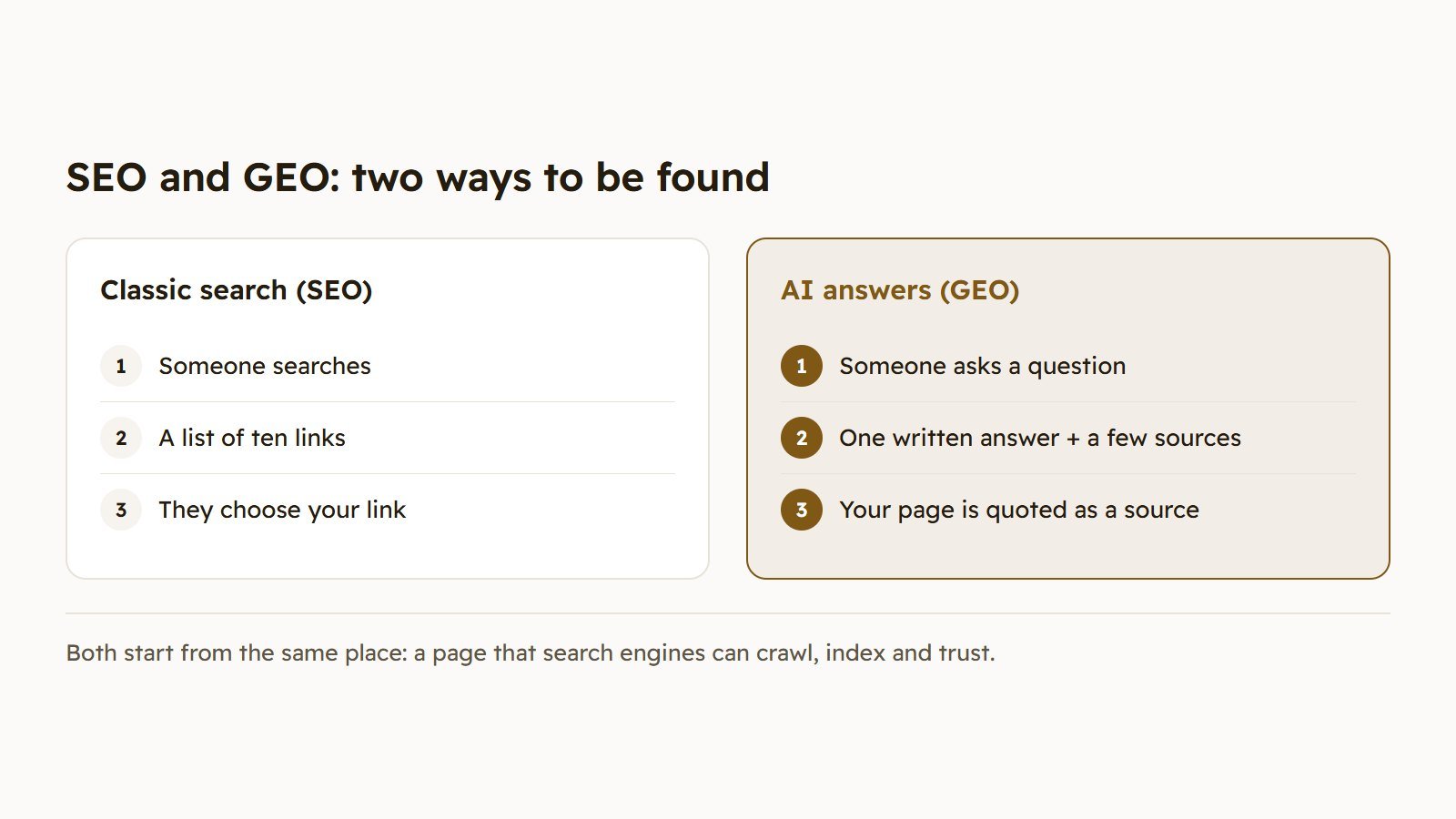
| SEO | GEO | |
|---|---|---|
| Goal | Rank a page in the results list | Be cited inside the AI answer |
| What the reader sees | Your title and description | A sentence built from your page, with a link |
| What wins | Relevance, authority, technical health | Clear facts, structure, and being the clearest source |
GEO does not replace SEO. Google says plainly that there are no extra requirements to appear in AI Overviews or AI Mode: a page only has to be indexed and eligible to show in Google Search with a snippet (Google Search Central). So the technical SEO work underneath stays the same.
What tends to get a page cited
- One clear answer near the top. A page that answers the question in its first paragraph is easier to quote than one that builds up to it.
- Facts stated plainly. Numbers, dates, prices and names written as full sentences, not buried in images.
- Structure the machine can read. Real headings, lists, tables, and structured data that describes the page (Google's introduction to structured data).
- Being reachable. OpenAI uses separate crawlers: OAI-SearchBot for ChatGPT search and GPTBot for training, and a site can allow one while blocking the other (OpenAI). And the page should not depend on JavaScript: an analysis by Vercel found that none of the major AI crawlers it tested render JavaScript, ChatGPT's and Claude's among them (Vercel).
The question to ask of every page is: if an assistant quoted one sentence from it, which sentence would that be — and is it true?
Where to start
Start with the pages that already bring enquiries from Google. They are already indexed and trusted; GEO is mostly about making their answers easier to lift.
Sources
- Aggarwal, P., Murahari, V., Rajpurohit, T., Kalyan, A., Narasimhan, K. and Deshpande, A. — GEO: Generative Engine Optimization, arXiv, 2023.
- Google Search Central — AI features and your website.
- Google Search Central — Introduction to structured data markup.
- OpenAI — Overview of OpenAI crawlers.
- Vercel — The rise of the AI crawler.