What goes wrong for tourists in Egypt: 7,771 reviews and posts, coded and counted
I coded 7,771 tourist reviews and posts about Egypt. With a tour company, the top complaint is not price: it is reliability and support.
 By Mahmoud Barakat

Photo: Ahmed Emad H, CC BY-SA 4.0, via Wikimedia Commons
Tour companies in Egypt usually assume tourists complain about prices and shopping stops. I wanted to check that against what tourists actually write, so I collected and coded 7,771 items — tour reviews, Reddit posts and comments, YouTube videos and comments, travel blogs and official travel advice — from 2023 to 2026. 3,437 of them were about a real problem or worry.
The short answer: with a tour company, the biggest complaints are reliability and support after booking, not price. Travelling independently, the biggest worry is safety and harassment — but most of it is worry, not something that happened.
How the study was done
| Source | What was analysed | Relevant items |
|---|---|---|
| Tour reviews (Tripadvisor, Google Maps, Trustpilot) | 905 reviews of tours and companies, mostly Cairo and Giza | 902 |
| 3,857 posts + 1,958 comments | 2,177 | |
| YouTube | 260 subtitle segments + 791 comments from 79 videos | 358 |
| Travel blogs, forums and news | 337 points from about 118 pages | 337 |
| Official travel advice (UK, Canada, Germany, New Zealand, CDC, Egyptian sources) | 104 points from 19 pages | 104 |
Every item was coded against a fixed list of 97 codes, so anyone can recount the numbers. A second, independent coding of part of the sample agreed with the first at F1 = 0.76 for reviews and 0.82 for social posts. In practice that means differences of 5 points or more are solid; smaller ones are not.
With a tour company: reliability beats price
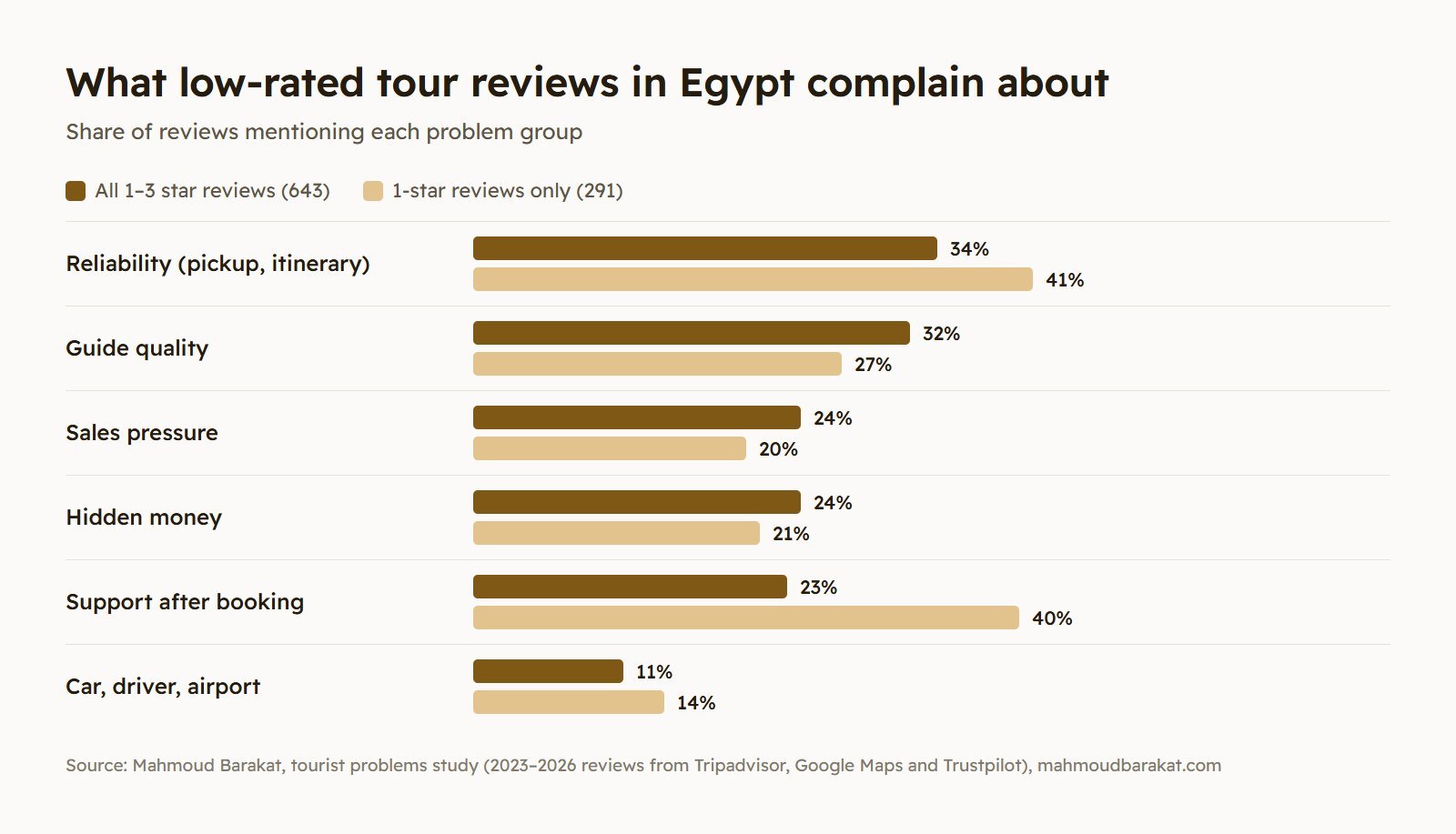
I looked at 643 reviews rated 1 to 3 stars. Grouped, the complaints look like this:
| Problem group | All 1–3 star reviews | 1-star reviews only (291) |
|---|---|---|
| Reliability (late or missing pickup, changed itinerary) | 34% | 41% |
| Guide quality | 32% | 27% |
| Sales pressure (shopping stops, commission shops, add-ons) | 24% | 20% |
| Hidden money (extra fees, tipping pressure) | 24% | 21% |
| Support after booking | 23% | 40% |
| Car, driver and airport | 11% | 14% |
The single problems mentioned most:
- Itinerary changed or stops skipped — 17%
- Forced shopping stop — 17%
- Late or missing pickup — 15%
- Rushed guide — 14%
- Guide with little knowledge — 14%
- Pressure to buy in a commission shop — 11%
- Hidden fees — 10%
Shopping stops are the most common single complaint in 2- and 3-star reviews. But 1-star reviews tell a different story: the angriest reviews are about a pickup that came late or never came (24% of them) and a complaint nobody answered (17%), followed by slow replies and refund disputes (12% each). Tourists forgive a shopping stop more easily than being ignored.
One more number worth knowing: 114 low-rated reviews (18%) praise the guide by name and still give a low score because of something else — the itinerary, the money or the support. A friendly guide does not save a trip that the office lets down.
Travelling independently: worry comes first
Among 1,015 items from independent travellers:
| Concern | Share |
|---|---|
| Safety and harassment | 30% |
| Arrival and getting around (visa, airport, Uber, taxis) | 27% |
| Scams and money | 23% |
| Heat, crowds, noise, dirt | 10% |
| Health | 3% |
Safety is the biggest concern, but of 136 general safety mentions only 20 described something that actually happened. The incidents that did happen were more ordinary: persistent hassle from sellers (64), sellers who would not take no (48), foreigner pricing (34), visa and airport arrival (33), Uber problems (31) and taxi fares (25).
Women travellers were the group with the clearest difference: 43% of their items mention general safety worry and 29% harassment.
What tourists say actually works
From their own advice, most-mentioned first:
- A firm "no, thank you" and ignoring sellers — 118 mentions
- A private, licensed guide — 97
- A private driver instead of a group tour — 53
- Asking the hotel — 42
- A small, recommended company — 24
- Going early — 24
And with companies, what makes people happy: an excellent guide (357 mentions), hospitality (257), good organisation and punctuality (207), and feeling looked after (112).
What a tour company can fix first
If I ran a tour company's website and operations, these are the first things the data points to:
- Pickup: a written pickup time, the driver's name and number the day before, and what happens if they are late.
- Itinerary: every stop with its time, and any change sent in writing.
- Shopping: say clearly whether there are shopping stops — and only promise "no shopping stops" if it is true.
- Money: what is included and what is not, as amounts, plus one plain line about tipping.
- Support: who answers, how fast, how to complain and how refunds work. This is the 40% of 1-star reviews.
Most bad reviews here are not about Egypt. They are about a promise the company made and did not keep.
Limits of the study
- Complaint bias: low ratings dominate the review sample; only about 260 positive reviews were analysed.
- Cairo and Giza heavy: 438 of the 643 low-rated reviews. Luxor, Aswan and the Red Sea need their own study.
- Missing platforms: Viator, GetYourGuide, Facebook, Instagram and TikTok were not included.
- Older travellers: only 25 items — too few for any conclusion.
- No company names are used, and no reviews are quoted word for word.
Sources
Where the data came from (all items from 2023 to 2026):
- Tour and company reviews from Tripadvisor (53 tour products), Google Maps (17 companies) and Trustpilot (5 companies), collected through the DataForSEO reviews API.
- Reddit posts and comments, collected from the Arctic Shift public Reddit archive.
- YouTube: auto-generated subtitles and top comments from 79 videos about travelling in Egypt.
- Travel blogs, forums and news: 337 points from about 118 pages.
- Official travel advice (104 points from 19 pages), including:
The full coded dataset — the list of 97 codes and every item with its link — is kept on file. Percentages are my own counts from that dataset.